Blog · 28 November 2026
Staircase trends for 2027: what is actually changing
Every autumn the design press publishes its forecasts for the year ahead. We read them with one question: which of these ideas change how a staircase is engineered and built, and which are only a new coat of paint? For 2027 the forecasts agree with each other more than usual. Here is what they say, and what it means in the workshop.
The staircase is the statement
House Digest expects the staircase as a focal point to be one of the big directions in homes, and points to Yelp's trend report, where searches for stair work have risen sharply. We see the same in the drawings we are sent. The stair is no longer pushed against a wall. It stands in the middle of the hall or the atrium, and the rest of the room is arranged around it.
A stair in the open is seen from every side, including from below. The underside, the edge of the stringer and the way the stair meets the floor all become visible surfaces, and they have to be designed, not just covered.
Solid, sculptural forms
Livingetc describes architects turning to enclosed, solid stairs that read as sculpture rather than as a light frame. In steel this is the closed box balustrade: two skins of plate with the structure hidden inside, filled, sanded and painted until no weld can be seen. The balustrade stops being something fixed to the stair and becomes the beam that carries it.
It is slower to make than a stair with spindles, because every square metre is a finished surface. It is also the form that photographs best and ages best.
Curves are staying
Helical and curved stairs appear in almost every list for the coming year. A curve softens a hard room and lets light fall past the stair instead of stopping at it. It is also the most demanding stair to engineer, which is why it is worth deciding early. We wrote about that separately in our piece on the return of the grand curved staircase.
Colour is back
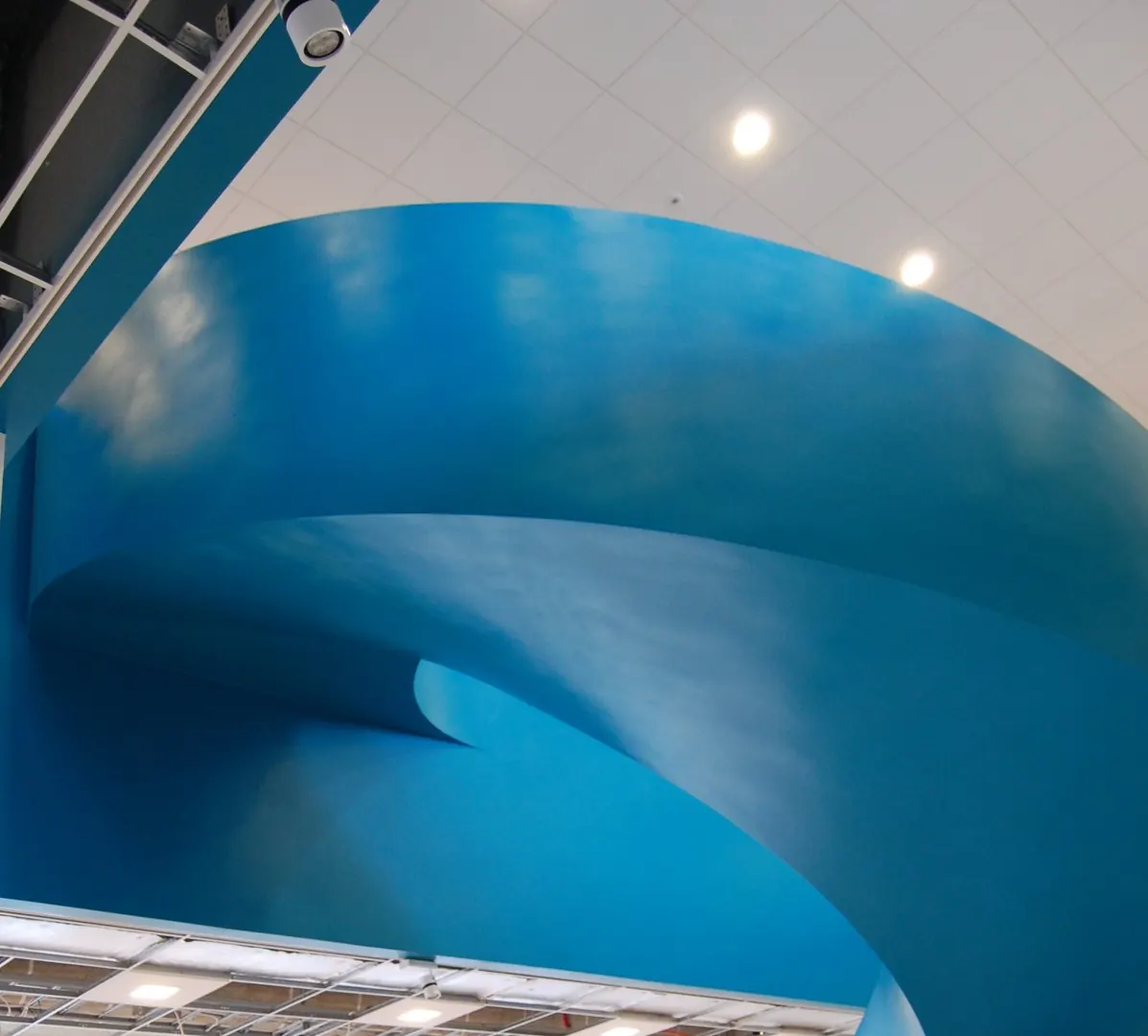
WGSN and Coloro have named Luminous Blue their Colour of the Year for 2027, and Livingetc was already showing a spiral stair in a deep gloss blue. After a decade of white, black and oak, a staircase in one strong colour is a real option again.
Painted steel takes any RAL or NCS colour, and a closed balustrade gives the colour a large, calm surface to live on. Our advice is simple: one colour, one object. Let the stair carry it and keep the room around it quiet. And remember that a colour can be repainted in ten years. The geometry cannot.
Light built in
Hidden LED lines under handrails, under treads and along the base of the balustrade are now expected rather than exotic. They only work when they are planned in the engineering stage, with channels, cable routes and access to the drivers drawn before the steel is cut.
Warm materials on a steel core
Pale oak and ash, terrazzo and stone on the treads, timber on the handrail where the hand meets the stair. The steel does the structural work and can stay slim. The natural material is used where people touch and see it most.
What we would not follow
A staircase stays in a building for fifty years or more. Choose the form for the building, not for the year. Take from the trends what helps the stair do its job: more light, a clearer line, a better handrail. Leave the rest to the cushions.
Sources: House Digest: the statement staircase in 2026 · Livingetc: enclosed staircases · Livingetc: staircase trends · Algedra: interior design trends 2027